Unveiling 'The Masks of Delusion'
Embark on an intellectual journey with Ziad Khalifeh's 'The Masks of Delusion', a profound exploration into the foundations of existence, consciousness, and the precarious state of modern civilisation. Discover how a lifelong quest for understanding has revealed the unifying principle behind our world's fragmentation: the law of balance. Arwad Publishing invites you to uncover truths often hidden beneath societal veneers.
"No ideology is legitimate until it passes the test of equilibrium."

A journey to the heart of balance
From profound questions about existence and consciousness to the seemingly fractured state of our world, 'The Masks of Delusion' delves deep. Ziad Khalifeh confronts the paradoxes of our age: why science, despite its vastness, seems impotent, and why humanity, despite its genius, stands at the brink. This book reveals that the intertwined crises we face are reducible to a single flaw: the disregard for the law of balance. Explore the intellectual journey across science, philosophy, and metaphysics that underpins this essential diagnosis.

Beyond the veils of modernity
'The Masks of Delusion' meticulously traces the cracks of modernity through five critical lenses: the illusion of control over nature, the illusion of limitless progress, the illusion of fixed identity, the illusion of absolute rationality, and the illusion of permanent stability. Ziad Khalifeh argues that true survival hinges not on strength or intelligence alone, but on restoring balance – in the mind, society, economy, and our relationship with our planet. Uncover the hidden truths behind these pervasive societal masks.
The common abstract: uniting truth
Uncover the profound convergence where science, religion, and philosophy meet in 'The Masks of Delusion'. Ziad Khalifeh introduces the 'Common Abstract' and the 'Vessel of Destiny', demonstrating how these fields, often seen as disparate, are bound by the truth of balance, 'Form', and 'Function'. This section explores the constants of biological function and teleological cause against the variables of form, revealing a universal framework for understanding existence and establishing ethics. It's a call to restore the architecture of reality, the unity behind multiplicity.

يقدّم هذا الكتاب مقاربة أنطولوجية متعددة المستويات لمسائل الخلق والوعي والزمن والحرية في ضوء النص القرآني، مع استحضار نقدي للتراث الكلامي والصوفي والفلسفي الإسلامي، ومقارنة معمّقة مع اتجاهات الفلسفة الحديثة وعلوم الوعي المعاصرة. ينطلق العمل من فرضية أن لغة القرآن لا تختزل في المجاز البلاغي، بل تكشف عن رؤية كونية متكاملة ترى الوجود فعلًا متجددًا ذا معنى، والوعي خاصية وجودية متدرجة لا تنحصر في الإنسان وحده.
يناقش الكتاب إشكالات مركزية مثل: مفهوم الخلق خارج ثنائية العدم والمادة، شمولية الوعي في الموجودات، العلاقة بين الأزلي والزمني في قضية خلق القرآن، التمييز بين وحدة الوجود والحلول، وحدود التفسير المادي للاوعي والإرادة الحرة. ويقترح إطارًا تركيبيًا يرى أن الكون قائم بالله دون أن يذوب فيه، وأن الزمن إطار إدراكي للتجلي لا قيدًا على السرمدية، وأن الحرية الإنسانية تتحقق داخل بنية سببية مفتوحة وموجهة بالمعنى.
لا يسعى هذا العمل إلى تأسيس نظرية علمية بديلة ولا إلى إعادة إنتاج مذهب كلامي، بل إلى بلورة أفق فلسفي جديد للحوار بين النص الديني والعقل الفلسفي والعلم المعاصر، بما يعيد الاعتبار للأسئلة الوجودية الكبرى حول المعنى والمسؤولية والوعي. ويقدّم الكتاب بذلك مساهمة في دراسات الفلسفة الدينية، وفلسفة الوعي، والهرمنيوطيقا القرآنية، بوصفه مشروعًا نقديًا تركيبيًا يربط بين الخلق بوصفه فعلًا دائمًا، والوعي بوصفه علاقة كونية، والإنسان بوصفه شاهدًا أخلاقيًا داخل كون مشحون بالدلالة.
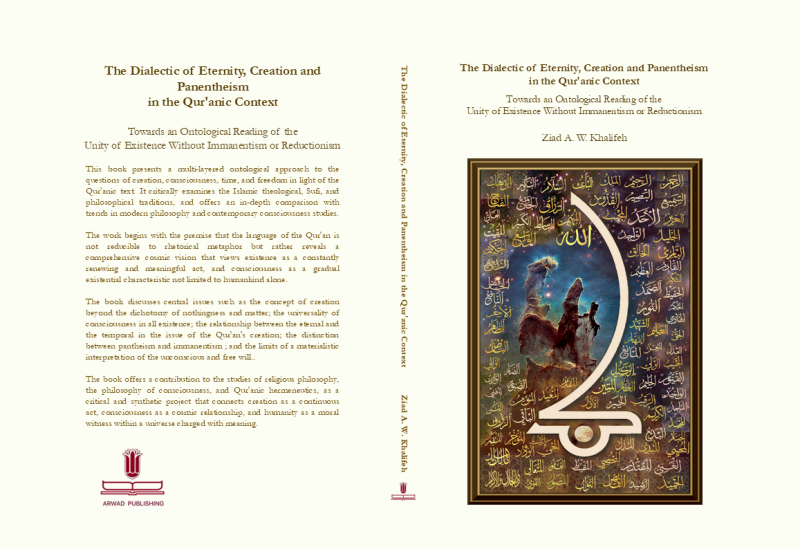
This book is based on a multi-layered ontological cycle exploring the questions of creation, consciousness, time, and freedom in light of the modern Qur'anic text. It critically examines the Islamic theological, Sufi, and philosophical heritage, and offers a comprehensive comparison with contemporary philosophical and consciousness-science trends. The work begins with the premise that the language of the Qur'an is not merely rhetorical metaphor, but rather a mirror reflecting a cosmic vision that focuses on existence as a constantly renewed and meaningful force, and on consciousness as a hierarchical quality not limited to humankind alone.
The book discusses central issues such as: the concept of creation between nothingness and matter; the comprehensiveness of consciousness in all existence; the conflict between the eternal and the temporal in the question of the Qur'an's creation; the distinction between pantheism and incarnation; and the limits of a materialist interpretation of the unconscious and free will. It proposes a synthetic framework that posits the universe as existing through God without being dissolved by Him, that time is a framework perceived for manifestation and cannot be applied to eternity, and that human freedom is realized within an open and meaning-oriented causality.
This work is not intended to challenge an alternative theory or to reproduce a theological doctrine, but rather to develop a new philosophical horizon for dialogue between text, philosophical reason, and contemporary science, thereby reconsidering the major existential questions of essence, responsibility, and consciousness. The book complements his contributions to studies in religious philosophy, the philosophy of consciousness, and Qur'anic hermeneutics, particularly his critical and synthetic project that connects creation.